






Semaglutide Patent Expires, Generics Enter the Market – Weight-Loss Miracle Drug Market Turns into a Red Ocean.
In 2023. inside a New York subway station, a giant billboard hung on the wall: a person injecting a needle into a seemingly bloated abdomen.
Another billboard nearby proclaimed in bold letters, “Inject once a week to lose weight.”
That drug was semaglutide – the weight-loss miracle drug repeatedly mentioned by US entrepreneur Elon Musk.
Originally developed to treat type 2 diabetes, it was found in studies to significantly reduce appetite and body weight. Soon, “weight-loss miracle drug” became its new label.
In 2022. Musk publicly stated that after using semaglutide, he lost 30 pounds (about 13.6 kg) with “very minimal side effects.” The “world’s richest man” endorsement quickly ignited the global market. A single starting-dose injection of semaglutide was once speculated to as high as 1.700 yuan per pen, and was extremely difficult to find. Novo Nordisk, the original drug’s manufacturer, achieved $36.1 billion in sales in 2025 based solely on this drug, and its market capitalization briefly surpassed luxury giant Louis Vuitton, becoming Europe’s “stock king.”
But this miracle did not last long.
The frenzy of capital and the market ignited the R&D passion of pharmaceutical companies. Just as semaglutide was at its peak, more potent competitors – tirzepatide, mazdutide, and other next-generation weight-loss drugs – roared onto the scene, carving up the massive weight-loss market. Among them, tirzepatide overtook semaglutide in 2025. becoming the “global drug king” with $36.507 billion in sales.
To cope with competition, Novo Nordisk repeatedly cut prices defensively for semaglutide, with prices in some markets nearly halved. As market expectations cooled, the pressure quickly transmitted upstream to API manufacturers. Starting in 2024. the price of semaglutide API has been falling continuously. “It dropped 50% last year, and is expected to drop another 40-50% this year,” revealed Zhao Xuan, an investor who has invested in multiple semaglutide API factories.
On March 20. 2026. semaglutide’s core molecule patent in China officially expired, opening the door wide. This also meant that a wave of generic drugs was about to hit, collectively carving up the hundreds-of-billion-dollar market.
But when more than a dozen Chinese pharmaceutical companies – Huadong Medicine, United Laboratories, and others – charge into the arena with their approvals in hand, they will find: there is no attractive cake before them, only a brutal red ocean that has been proactively cleared by the original drug’s price cuts and crushed by the technological superiority of next-generation drugs.
A destined-to-be-arduous breakout battle has already begun the moment the entrants received their tickets.
Miracle Drug, No Longer Miraculous
In the entertainment industry, using semaglutide for weight loss has become an open secret.
According to the US entertainment magazine Variety, in 2022. semaglutide swept almost all of Hollywood. Influencers, celebrities, producers – all privately raved about Ozempic (the diabetes version of semaglutide).
The drug’s mechanism is not complicated. It mimics the natural hormone GLP-1 in the human body, controlling blood sugar while sending a “full” signal to the brain, thereby suppressing appetite and achieving weight loss.
Because of its excellent weight-loss effect, this blockbuster product gave rise to the term “Ozempic face,” referring to the rapid loss of fat and muscle, leading to loose skin and sunken facial features. Some companies even started targeted pharmaceutical research on this phenomenon.
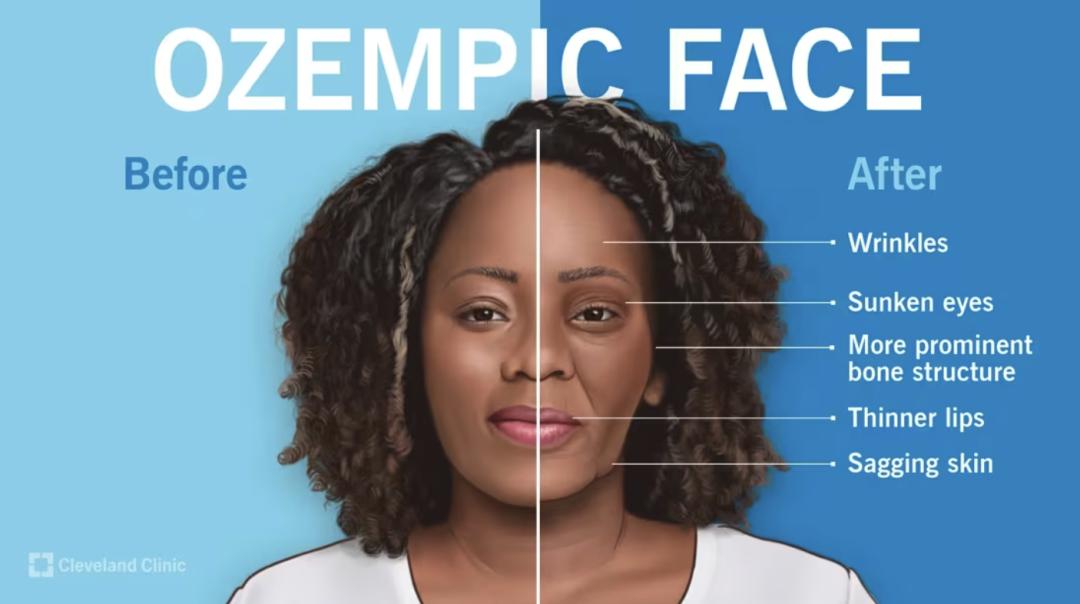
Source: Cleveland Clinic, USA
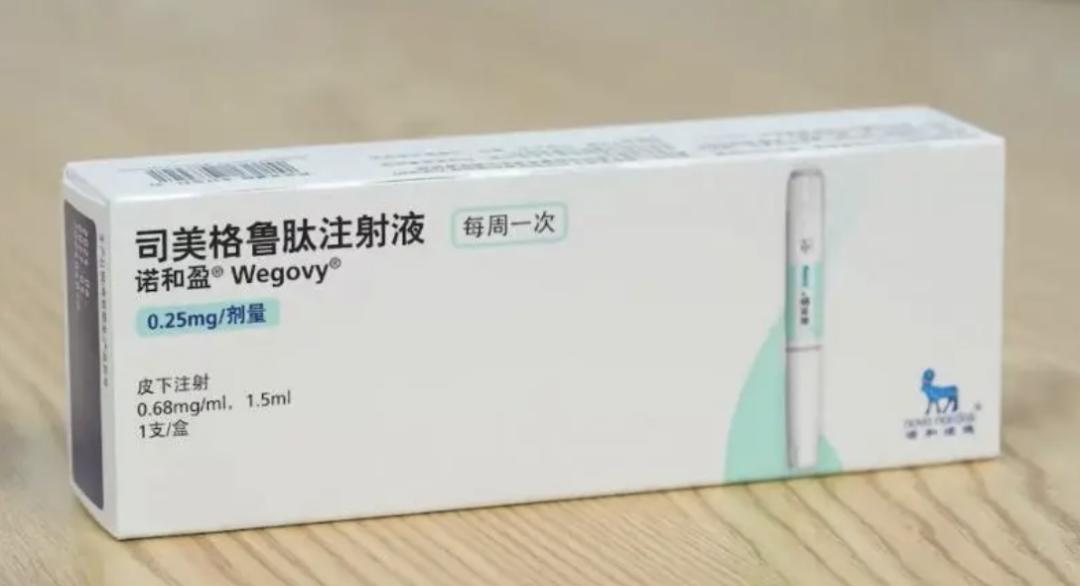
But side effects could not stop people’s desire for a good figure. After its explosive popularity, the weight-loss miracle drug once fell into shortage. In 2023. domestic supply of semaglutide in China was critical, and many diabetic patients reported being unable to buy the drug. Although semaglutide had not yet been approved for weight-loss indications in China at that time, a considerable number of users ordered it through online medical platforms, attempting “off-label use.” In 2024. Wegovy (the weight-loss version of semaglutide) was officially launched in China, with an initial price of approximately 1.400 yuan (1.5ml, 0.68mg/ml starting dose pen). Within a week of launch, it was speculated by channels to 1.700 yuan and repeatedly sold out.
From 2021 to 2023. semaglutide’s annual sales rapidly climbed from
5.88billionto21.2 billion, nearly quadrupling. Novo Nordisk’s market value soared as a result, surpassing Louis Vuitton for the first time in September 2023 to become Europe’s most valuable company, and hitting an all-time high of approximately $650 billion in June 2024.
Clearly, what truly drove this pharmaceutical giant’s valuation surge was not the saturated diabetes drug market, but the “Pandora’s box” of global weight loss it unintentionally opened. Semaglutide elevated “weight loss” beyond traditional medical scenarios, turning it into a mega-business targeting hundreds of millions of consumers. Market research firm Goldman Sachs predicted that by 2030. the weight-loss drug market based on GLP-1 injectables would reach $95 billion.
This huge cake immediately ignited an arms race among global pharmaceutical companies. In 2022. US drugmaker Eli Lilly’s diabetes/weight-loss drug tirzepatide was approved. It added a new target, GIP, which acts directly on fat tissue, on top of GLP-1. Simply put, its weight-loss effect was stronger. Semaglutide achieved 15-18% weight loss, while tirzepatide achieved 22%. Eli Lilly was ambitious, with executives repeatedly stating publicly that their goal was “not just to offer another option” but “to redefine the standard of care for obesity.”
Meanwhile, Chinese drugmaker Innovent Biologics also formed a strong partnership with Eli Lilly to jointly develop mazdutide. Besides weight loss and blood sugar control, it can also promote the oxidation and metabolism of liver fat, targeting the large population of fatty liver patients.
The successive launch of next-generation drugs quickly shook semaglutide’s position.
Zhang Xiaodong, a regional manager at a top-tier healthcare company, said: “Consumers only care about results.” He had tried both semaglutide and tirzepatide. “Tirzepatide suppresses appetite much more noticeably. Also, semaglutide has some worrying side effects – some male users report ED (erectile dysfunction).”
He also revealed that under the influence of new drugs, demand for semaglutide in private channels is rapidly shrinking. “A major private channel supplier in the Southwest region used to sell 20.000 pens a month. Now they can’t even sell 200. Everyone in private channels has switched to tirzepatide.”
Elon Musk, who long endorsed semaglutide, revealed at the end of 2024 that he had switched to tirzepatide. In 2025. tirzepatide’s sales overtook semaglutide, officially becoming the “global drug king.”
Additionally, tirzepatide was officially included in the national medical insurance at the end of last year, reducing the monthly cost for a low dose from 1.700 yuan to just over 300 yuan. Although its insurance coverage indication is only for treating type 2 diabetes, the audit is not strict, and weight-loss users can easily obtain it through online platforms, further eating into semaglutide’s market.
In February 2026. Novo Nordisk released its 2026 performance guidance, forecasting a 5% to 13% decline in sales at constant exchange rates – its first negative growth in nearly nine years. It specifically highlighted the pressure on “injectable GLP-1 drugs” (semaglutide’s main component). The announcement wiped over
100billionfromNovoNordisk’smarketcapinasingleday.ByearlyApril,itstotalmarketvaluehadfallenbelow170 billion.
Meanwhile, another shock was approaching. On March 20. 2026. semaglutide’s core molecule patent in China officially expired, and more than a dozen domestic drug companies had already submitted generic drug applications. The market structure, once dominated by Novo Nordisk, was rapidly moving toward fragmentation.
The Unstoppable Generics
To cope with competitive threats and the impending generics war, semaglutide repeatedly cut prices in the second half of 2025 to survive.
At the end of last year, Novo Nordisk announced that it would reduce the monthly cost of Wegovy and Ozempic in the US market to 199.withthediscountlastingtwomonthsbeforereturningto349 per month. Compared to the previously listed monthly cost of up to $1.300. prices fell sharply. In China, procurement platforms in Yunnan and Sichuan provinces showed price cuts for Wegovy of over 50%.
Its price system on online platforms collapsed simultaneously. The starting dose of Wegovy, initially priced at about 1.400 yuan at launch in China, now has online prices even lower than the original fraction. Zhang Xiaodong revealed, “The wholesale price on platforms like Meituan and JD.com is about 180 yuan, and the selling price is 230 yuan.”
The pressure of market competition had long been transmitted upstream. Zhao Xuan said that since 2024. the price of semaglutide API has been continuously falling. “It dropped 50% last year, and is expected to drop another 40-50% this year.”
This change is mainly due to a reversal in supply and demand. Over the past two years, as the semaglutide market rapidly expanded, upstream API manufacturers all expanded production, and capacity quickly rose. Public information shows that Poly Pharm, known as the “capacity king,” put its semaglutide production line (12-ton fermentation scale) based on synthetic biology technology into trial production in 2025. and plans to further expand the fermentation system to 50 tons/year in the long term.
Meanwhile, as the technical barriers to API production have been gradually overcome, more and more companies have entered the field, intensifying competition. “Some companies that weren’t even in pharma before are also participating,” Zhao Xuan said.
When the growth rate of semaglutide end-user demand slows down, and production capacity has been massively released, API prices naturally fall. “In the long run, there may even be overcapacity and price wars among API factories,” Zhao Xuan predicted.
However, falling API prices have not eroded the high profits of the production segment too much. Thanks to improved production efficiency and optimized synthesis processes, API companies have significantly increased output per batch, spreading fixed costs. “For example, in the past, only 6 kg could be produced per batch, but now 8 kg can be done; or the reactor size has been expanded from 150 liters to 250 liters – unit costs naturally fall.”
Zhao Xuan revealed that although industry gross margins have fallen, they remain high. “Before, the gross margins of these invested API companies were about 70%. Now, gross margins are still high at 50-60%, and that’s a conservative estimate.”
For drug manufacturers, the profit margins are even more astonishing. Zhao Xuan revealed that the current selling price of API is about 2.000-3.000 yuan per 1.000 mg. Taking Wegovy at a dose of 1.5ml (0.68mg/ml) as an example, the active ingredient is about 1.02 mg. Based on this, the API cost of a single pen is only about 2-3 yuan (excluding the injection pen device, filling, packaging, etc.). Yet the monthly treatment cost of semaglutide is typically hundreds to thousands of yuan. Zhao Xuan stated that the net profit margin of semaglutide injections is over 90%.
Source: Internet
This also explains why, after the halo of semaglutide as a miracle drug faded, generic drug companies still swarmed in.
On the one hand, no one wants to give up the high profit margins and the proven hundreds-of-billion-dollar market. Moreover, from a cost perspective, generics can save a huge amount on R&D expenses. Liu Siming, an executive at a pharmaceutical company, revealed that original drug R&D follows the “ten-year, billion-dollar” rule – ten years of R&D and one billion US dollars in cost. Since generics do not bear the burden of early-stage R&D and large-scale trials, they can often save hundreds of millions of dollars.
On the other hand, companies wanting to produce generics had already started building production lines three to five years before semaglutide’s patent expired, or even earlier. Having already invested substantial assets, exiting would incur high sunk costs. “(Generic companies) are like a ship that cannot turn around,” Zhang Xiaodong metaphorically described.
Today, more than ten pharmaceutical companies – Huadong Medicine, United Laboratories (Federated), Qilu Pharmaceutical, and others – have submitted registration applications, awaiting final approval for market launch.
It is foreseeable that once generics hit the market, a price war will be unavoidable.
From a commercial strategy perspective, generics will most likely adopt a “price for volume” route: first, use low prices to capture market share, then spread costs through economies of scale to sustain operations. In Zhang Xiaodong’s view, “maybe only two or three major factories have the strength to fight this war of attrition.” For smaller drug companies, even if initial profits are not impressive, they have no choice but to follow – because once production lines sit idle, the consumption of fixed costs becomes even more deadly.
Furthermore, market segmentation may become key. Liu Siming believes that the original drug’s early price cut has indeed squeezed the development space for generics – especially in first- and second-tier city markets, where users can mostly afford the original drug and are not price-sensitive. But the situation is different in third- and fourth-tier cities. If generics enter the lower-tier market, their low-price advantage will be amplified, possibly even activating a brand-new, large user base that previously could not afford the original drug.
The Next Phase of Semaglutide Competition
As semaglutide retreats step by step amid fierce price wars and efficacy competition, the real test has just begun for Chinese generic drug companies holding approvals and about to enter the market. What they are fighting for is no longer the throne of the “miracle drug,” but rather finding their own survival niche in a prematurely squeezed, stagnant market.
Currently, most pharmaceutical companies have submitted generic semaglutide applications for the indication of “type 2 diabetes.” However, some are pursuing clinical trials and registration for the weight-loss indication, such as Jiuyuan Gene, Livzon Pharmaceutical, CSPC Pharmaceutical, and Hanmi Pharmaceutical. Among them, Jiuyuan Gene’s independently developed semaglutide weight-loss indication marketing authorization application has been formally accepted by the drug regulator and is in the review stage.
The list of domestic companies applying for weight-loss approval is expected to expand further this year.
Liu Siming believes that because the weight-loss patient population is vast and willing to pay, even if generics are approved for the diabetes indication, “off-label use” is very likely to occur during distribution.
It is not difficult to obtain semaglutide in China. Some internet healthcare platforms only require users to fill in pre-existing diagnosis information to quickly issue an electronic prescription and sell the drug. The platforms often do not require offline diagnostic proof. Therefore, for generic drug companies, aggressively developing online and private channels under the compliance framework to directly reach weight-loss users will become a key battlefield alongside hospital sales.
Zhao Xuan speculates that oral formulation may be the next race for generics.
Although Novo Nordisk’s original oral semaglutide (Rybelsus) was launched in China early last year, domestic generics are still limited to injectables. Compared to injections requiring cold-chain transport and invasive administration, oral drugs are easier to store and carry, and users are more likely to form habits. Any drug company that can take the lead in overcoming the technical hurdles could jump ahead in the race.
However, because the drug must survive stomach release to be effective, the oral formulation of generics demands higher production technology, and the approval process can take 3-5 years. In Zhang Xiaodong’s view, betting on oral generics is a gamble with time. “I don’t think semaglutide has such a long life cycle.”
It is worth noting that the intensifying competition over semaglutide is bringing side effects to the market.
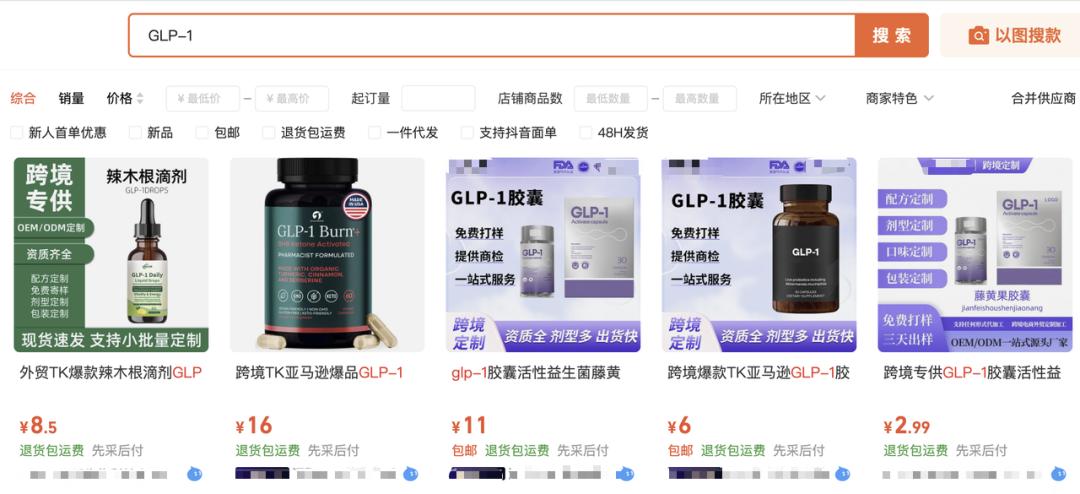
*Searching for “GLP-1” on a B2B platform shows vendors offering one-stop pharmaceutical services. Source: Internet*
Zhao Xuan observed that as upstream API capacity continues to be released and prices fall, some APIs are leaking through informal channels. In the industry, there are cases of privately procuring APIs and preparing drugs, infringing patents. In 2023. authorities busted a cosmetics production company that contacted API suppliers, packaged products containing semaglutide components under cosmetic registration numbers, and sold them. That was the country’s first case of illegal production and sale of semaglutide injections.
“It’s indeed illegal, but you can’t catch them all – there are too many,” Zhao Xuan said. Driven by profits, this gray chain is unlikely to disappear completely.
Although semaglutide’s market prospects are narrowing, the “obesity economy” it leveraged is still a growing business.
Over the past two decades, the prevalence of overweight and obesity among Chinese adults has continued to rise. A study in The Lancet’s sub-journal showed that from 2004 to 2023. the rate increased from 30.1% to 56.9% – nearly doubling. Combined with body image anxiety and health management needs, weight-loss drugs carry both serious medical value and consumer healthcare attributes, creating an even broader market space.
Currently, the weight-loss drug market is still in a period of rapid development, shifting from a single miracle-drug-centered model to a phase where innovative drugs flourish. It is reported that Novo Nordisk is continuing to advance new drug R&D. On March 25. Novo Nordisk and United Laboratories jointly announced positive progress in a phase II diabetes study for the next-generation weight-loss drug “UBT251.” with results showing superior weight control compared to semaglutide.
Eli Lilly is also advancing clinical research on orforglipron, an oral weight-loss drug. A doctor at a tertiary hospital who has long used semaglutide told Mirror Workshop that he participated in the phase III trial of orforglipron and “gained a lot. Not only was the weight-loss effect definite, but overall metabolic indicators such as uric acid and blood lipids also improved significantly.”
These cases reveal an industry rule: semaglutide may become a thing of the past, but innovators who master iterative capabilities will not.
The reason generics are expected to fall into a red ocean is that their competitive logic is locked into a “follow and copy” path, typically three to five years slower than the market. When new drugs are already the market’s new favorites, generic companies are still waiting for the previous generation’s patent walls to collapse, “taking over” a saturated market with weak growth and thin profits.
Ultimately, in this long-term battle around human weight and health, the only moat is the ability to continuously iterate forward. For Chinese pharmaceutical companies, the biggest lesson from semaglutide is that they must move from the comfort zone of “followers” into the deep waters of “innovators.” Only by betting on the next generation can they transcend cycles and avoid a winnerless war of attrition in the afterglow of the previous generation’s miracle drug.
(All interviewees are pseudonyms)
This article was originally published on WeChat public account “Mirror Workshop” by Feng Ye.
The views expressed are solely those of the author. This platform provides only information storage space.