







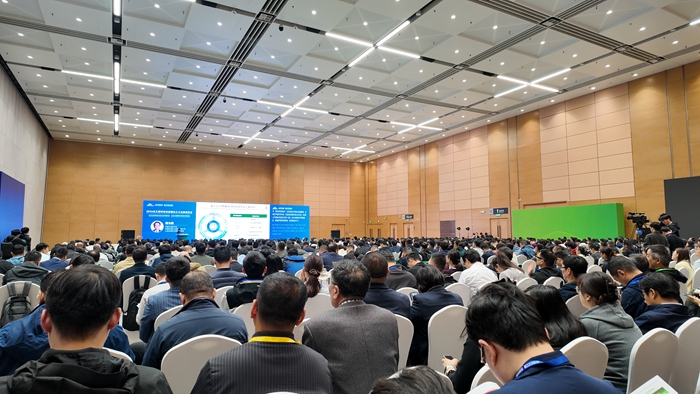
China Chemical News Net – The 2026 Conference and Exhibition on New Chemical Materials and Fine Chemicals was recently held in Suzhou. Academician Yang Weimin of the Chinese Academy of Engineering and Academician Jian Xigao of the Chinese Academy of Engineering attended the conference and delivered reports. Experts at the meeting stated that to achieve the goal of becoming a petrochemical power, new chemical materials remain the biggest shortcoming.
Since the 14th Five-Year Plan, China’s new chemical materials industry has achieved leapfrog development. In 2024. the industry’s self-sufficiency rate reached 81%, exceeding the target. In 2025. the industry’s scale exceeded 1.5 trillion yuan, a 110% increase from 2020. However, the self-sufficiency rate in segments such as high-end polyolefins is still below 50%. During the 15th Five-Year Plan period, the industry must strengthen its capacity to supply high-end products.
Xie Hongliang, an expert from the Epoxy Resin and Application Professional Committee of the China Petroleum and Chemical Industry Federation, stated that China is currently at a critical juncture of planning for the 15th Five-Year Plan. The industry is shifting from scale expansion to quality improvement, from low-end supply to high-end breakthroughs, and from following and imitating to leading independently. At the same time, the industry faces challenges such as insufficient high-end supply, pressure from green transformation, and bottlenecks in key materials. Currently, about 30% of China’s key strategic materials remain undeveloped, and over 50% rely on imports. The external dependence for semiconductor-grade epoxy resins, high-end electronic chemicals, and specialty catalytic materials remains high.
Zheng Baoshan, Vice President of the China Petroleum and Chemical Industry Planning Institute, pointed out that during the 15th Five-Year Plan, the focus will be on breaking through key product development and fostering collaborative innovation along the upstream and downstream. He explained that the main shortcomings in the development of new chemical materials are concentrated in six areas: absolute supply shortages, insufficient capacity release, weak application technologies, constraints on key raw materials, poor market promotion, and substitution results falling short of expectations. Among these, insufficient technical capability is the core issue. “Inferior technology is the main contradiction; the overall technical level still lags behind leading foreign enterprises.”
Regarding the development during the 15th Five-Year Plan, Zheng Baoshan proposed four key directions: accelerating the industrialization of product varieties that are currently missing, improving the quality of existing varieties, breaking supply bottlenecks for key supporting raw materials, and enhancing customized service capabilities. “Compared with basic products, the gap between China and foreign countries is even more significant for products that users actually need, such as composite materials.” He emphasized that meeting the special needs of different customers will be a key task during the 15th Five-Year Plan period.
On specific measures, Zheng Baoshan introduced the “open competition mechanism” for fine chemical products already launched by the Ministry of Industry and Information Technology. The first batch of 111 projects has entered the public notification list, covering key varieties that have long relied on imports, such as polyetherimide and specialty isocyanates (cyclohexane dimethylene diisocyanate, 1.4-cyclohexane diisocyanate, and naphthalene diisocyanate). He particularly emphasized the importance of collaborative innovation along the upstream and downstream: “Meeting specifications does not mean the product can be used by downstream users.” Chain-based innovation should be pursued, with the ability to meet downstream user needs as the evaluation criterion.
Bai Hongqiang, President of the Beijing Institute of New Chemical Materials, called on downstream enterprises to cherish the current stable market situation, continue to promote “anti-involution” efforts, and guide enterprises to invest resources in the development of high-end applications rather than repeating the mistakes of low-level expansion of upstream production capacity. At the policy level, for basic new chemical materials such as organosilicon that face overcapacity problems, he suggested that upstream facilities that have been in operation for more than 15 years should be mandatorily included in elimination or transformation plans, with policy support. He also recommended listing them as “restricted” in the industrial guidance catalog, guiding credit funds toward high-end applications, and strengthening supervision.
The conference was hosted by the Beijing Institute of New Chemical Materials.